Show Me
Work-integrated learning (WIL) opportunities prepare you for the world of work.
“Importantly, positive WIL experiences ensure that students have educationally sound opportunities to further develop and demonstrate their learning and build their professional networks.”
Tertiary Education Quality and Standards Agency (TEQSA)
Faculty of Law and Business courses offer you WIL experiences throughout your degree. These experiences provide you with real-life experience, network opportunities and the chance to hone your skills before you graduate.
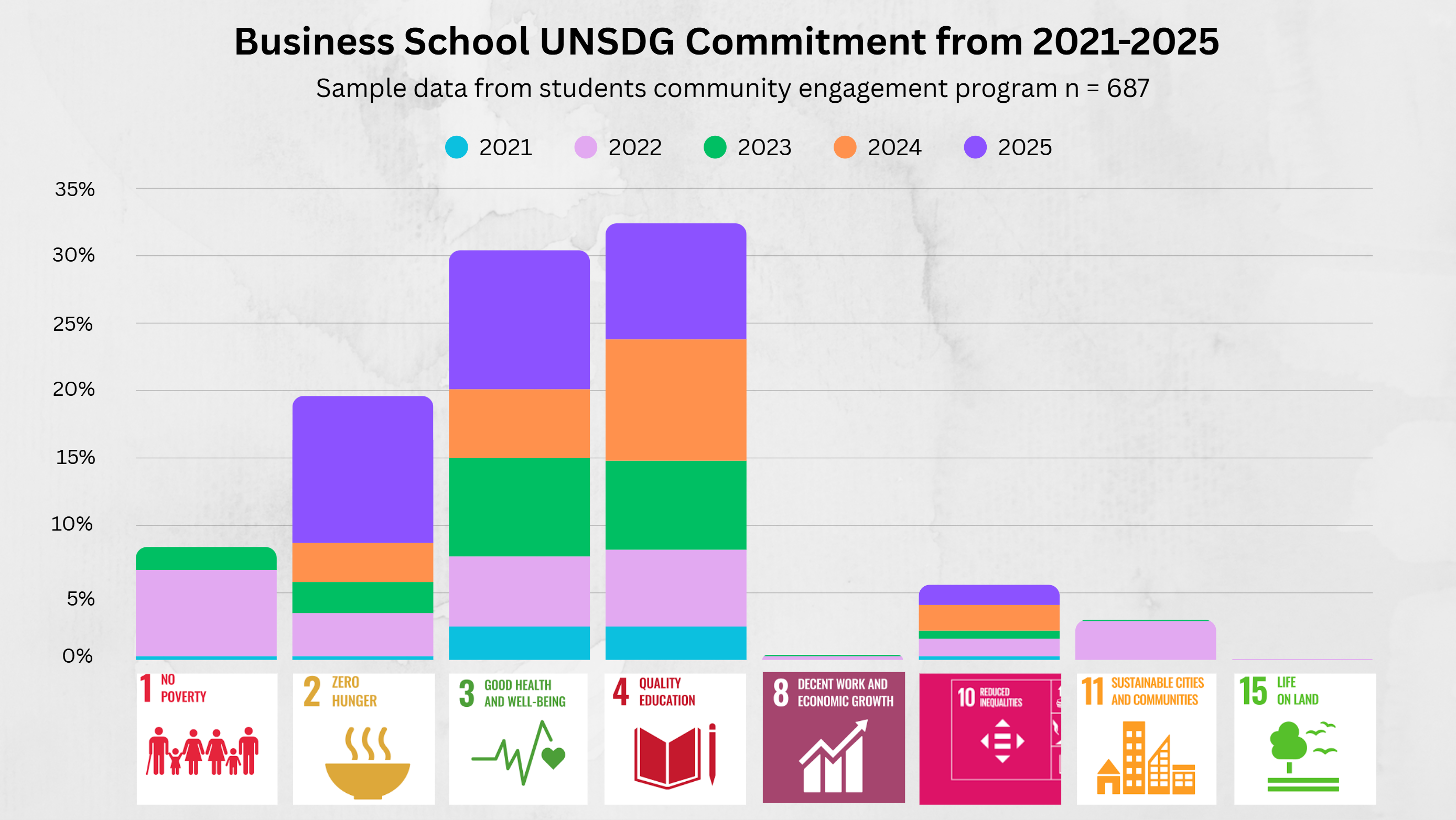
ACU’s Community Engagement allows students to gain valuable experience while working with the community to advance the common good. The Peter Faber Business School embeds the United Nations Sustainable Development Goals (UNSDG) into many of the available community engagement units undertaken by students in the school.
During the unit, students work on projects designed to alleviate poverty and hunger, provide quality education, promote good health and wellbeing, and reduce inequalities.
Being around children has always been fun for me, and I have always wanted to volunteer to help them. The community engagement volunteer placement as part of my degree was the push I needed in the right direction to get me started. I think it’s great that this is incorporated into my degree because it opens our eyes to another aspect of life as well as broadening my skills when joining the workforce. Volunteering is a fantastic way to make you appreciate what you have and be more generous with helping others.
Ella McNulty
Bachelor of Commerce (Marketing)
Nano projects are short term internships that offer students the opportunity to gain real-world experience.
The Boroondara project involved data science students working with a small team of data scientists over two weeks to label trees in aerial images. This provided students with real-world practical training using machine learning models to track the tree canopy coverage over time. Students were given opportunities to use state-of-the-art tools by Microsoft for image labelling, including machine-learning-assisted labelling, open-source machine learning tools for deep learning and image classification. Additionally, students also got an understanding of the end-to-end machine learning process with real-world data – not just model building, but also data preparation, model deployment and model monitoring.
Tree Coverage – data labelling project
The objectives of the project are to provide geo spatial layers of tree canopy for Boroondara, tree canopy geo spatial outputs based on suburb boundary, tree coverage analysis, like the tree coverage percentage, and output integration with ArcGIS. Students worked with a small team of data scientists from Accenture (IT company) over two weeks during summer break to label trees in aerial images. This has been used by the data scientist tracking the tree canopy coverage over time using a machine learning model to assist with strategy and planning around climate change and biodiversity. Overall, 5 FLB-ACU students created 456 image labels for this project using the data science concepts they learnt in their courses.
The competition was designed to give students real-world experience to pitch their ideas for one of two categories: seed and early-stage. Judges evaluated the seed category based on the market opportunity and concept validation of the business idea. Judges evaluated the early-stage category, presented by young entrepreneurs who had more developed business models.
The best pitches walked away with cash prizes, mentoring opportunities, in-kind services and much more, totalling over $50,000 in combined prizes.
Investors armed with $80 million in virtual cash swooped on ambitious student start-ups as part of a Shark Tank styled assessment for budding Australian and US entrepreneurs. The assessment was the culmination of the Global Virtual Intercultural Program (GVIP), a business unit to nurture a sense of connectivity, global citizenship and the development of new skills such as cultural IQ in students from each school.
Australian and US students swim in the virtual global Shark Tank
Global Zoom classroom brings grad students together from Nazareth and Australia
ACU Students Tackle Social Isolation: Medibank Extends Partnership to Roll Out ‘No One Eats Alone’ Initiative Across ACU Campuses and National Campaign
In a powerful example of industry collaboration and student impact, the Medibank-funded FLB industry placement project “Addressing Social Isolation and Loneliness” has achieved outstanding success. Originally conceived to help support students experiencing financial stress during their placement year, the project team could see a strong connection to loneliness and so the focus of the “No One Eats Alone” initiative evolved. Following its success, This initiative will also be rolled out to ACU campuses within the coming months. This has also has now been integrated into Medibank’s national campaign, The Family Roast Game.
Led by final-year Business students Lauren Paddick-Croft, Ngima Lamu Sherpa, Niamh Mansfield and one more peer, the WIL project delivered a powerful, research-informed proposal to tackle loneliness among young adults. The team collaborated with Medibank’s Partnership Managers, Cathy and Susan, with guidance from Project Manager Emma Simpfendorfer. A big thanks to Susan, Cathy, Emma, and the student team for their exceptional work.
The students’ presentation received enthusiastic praise from the Medibank team. Cathy, Medibank Partnership Manager, shared: “The feedback from the Medibank team was extremely positive—they really enjoyed the student presentations. I was particularly impressed by the professionalism and depth of thinking behind their ideas.”
An international student from the UK remarked, “I’ve personally experienced the challenges of loneliness after moving to Australia. Being involved in this project with Medibank has been incredibly meaningful - it’s enlightening to see a company not only listen to student voices but also take real action. It feels like a genuine step in the right direction.” Another student added, “This project not only gave us real-world experience -it opened doors to future career opportunities.”
Judges Myriam Amielh and Bronwyn Bartsch commended the students' innovation and practical application. Implementation of the initiative is now underway, with Global Engagement Director Bronwyn Bartsch leading efforts to connect with staff across campuses to explore a university-wide rollout.
From classroom to community, ACU students are leading change—proving that even a simple idea like ensuring ‘no one eats alone’ can transform the student experience.
The faculty’s learning and teaching team successfully gained an Experiential Learning Innovation grant from Practera to pilot an industry-based internship opportunity to our students. This gave opportunities to all students enrolled in the final year capstone unit to undertake practical real-life projects to holistically develop application knowledge and soft skills across various disciplines since 2020.
The aim of the project is to design, develop and deliver a final year capstone unit for business students at Australian Catholic University (ACU) with a substantial internship component harnessing the powerful digital, networking and other capabilities of Practera. Practera’s versatile capabilities, including analytics, digital, industry connections and personnel experts, are a perfect fit to meet our requirement of the scalable provision of WIL opportunities to our students.
The Practera pilot offered students an authentic work-integrated learning (WIL) opportunity in the form of a a six-week industry-based practical project. Adopting the team-based learning (TBL) pedagogy, students were allocated into small groups to solve a practical, real-world problem posed by the industry partner. The industry partner acted as their client, mentor and evaluator until the project completion. This is a win-win proposition to both students and employers on a large scale.
Employers benefit from access to a large pool of fresh/novel ideas, pro bono work, recruitment pathways, hone their staff skills in mentoring and management, and fulfill their corporate social responsibility (CSR) obligations. Students benefit by connecting with industry and holistically enhancing their knowledge, skills, and ability including: application knowledge, employability skills, and professional and personal identity. Additionally, this is aligned with ACU’s ethos of fairer access to authentic experiential learning opportunities to all including remote, regional and low SES students and paves the way for fulfilling the United Nation’s sustainable development goal (SDG).
The Riipen industry-based assignments project supports the nuanced needs of students developing their work-ready skills. Riipen is an online learning platform that connects students and industry.
This project offers students more opportunities to gain work experience within the industry while they are studying, allowing them to develop employability skills that will meet the demands of their future job makers.
The project was first introduced for students in the Peter Faber Business School in Semester 1, 2023. The industry-based assignments were embedded into the assessment of three undergraduate units: ITEC200, MKTG207, and MKTG209.
We're available 9am–5pm AEST,
Monday to Friday
If you’ve got a question, our AskACU team has you covered. You can search FAQs, email, live chat, call – whatever works for you.