
Show Me
What makes a life good? And what does the answer ask of universities? ACU’s Vice-Chancellor and President Professor Zlatko Skrbis introduces his keynote address for the 32nd ASEACCU General Assembly and Conference, published here in full.
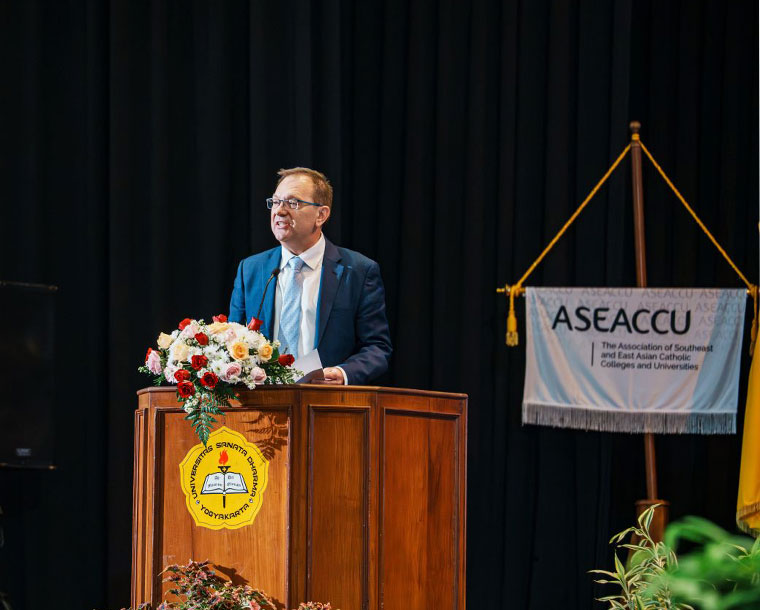
Last month I had the privilege of opening the ASEACCU conference in Yogyakarta, among colleagues representing Catholic universities from across southeast and east Asia.
My subject was human flourishing, a topic that runs through much of what we do at Australian Catholic University.
Human flourishing is not a new idea. Century after century, many different cultures, philosophies and religious traditions have asked what makes a life good.
Today we ask it in a period of declining trust in institutions, while new technologies rapidly change how we learn, how we create, and how we attend to one another.
In this environment, how do we use knowledge to help human beings flourish? And what role do universities, and especially Catholic universities, play in shaping the conditions in which flourishing becomes possible?
In my ASEACCU keynote lecture, I argue that the response is one that universities have been practising for almost a thousand years: holding knowledge together, and forming whole persons in the company of others.
I hope you’ll take the time to read it.
Read the full keynote address, delivered at the 32nd ASEACCU General Assembly and Conference at Universitas Sanata Dharma, Yogyakarta, on 19 August 2026.
This article is part of the Vice-Chancellor’s Blog, which highlights stories, insights and perspectives from across the university.
We're available 9am–5pm AEST,
Monday to Friday
If you’ve got a question, our AskACU team has you covered. You can search FAQs, email, live chat, call – whatever works for you.

 Facebook
 Twitter
 LinkedIn
 Copy Link