Show Me
Religious education expert Dr Maurice Ryan traced the forgotten history of lay Catholic teachers in Australia at a recent public lecture at Australian Catholic University’s Brisbane Campus.
Dr Ryan, a scholar and former ACU academic based in Brisbane, shared the stories of lay teachers during Australia’s colonial era at the Biographical Dictionary of Catholic Educators’ (BDACE) second public lecture.
A common misconception, according to Dr Ryan, was Catholic schools were started from scratch in the 1870s and 1880s, under the leadership of the Bishops who recruited religious priests, Brothers and Sisters from Europe to replace lay teachers, and attended only by Catholic children
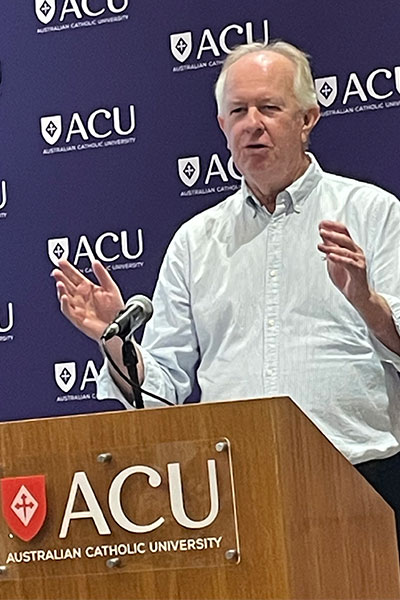
“I’ve got only one issue with this story – none of it is true,” Dr Ryan said.
“It leaves out the people who should be in that story, the lay people.”
Dr Ryan’s research into the make-up of Catholic schools in early colonial days, published in his book Cover Stories - Lay Teachers in Australian Colonial Catholic Schools, found most teachers in 19th century Catholic schools were lay, Irish emigrants.
“Catholic schools in this country were founded by lay people,” Dr Ryan said.
Dr Ryan shared the story of three pioneering teachers, all of whom were lay Catholics.
Miss Mary Troy, who came from an entrepreneurial family and was well-connected with both society and church, was 19 when she opened her first school in Elizabeth Street Sydney in 1841. She could afford to run the school in the “ritzy” part of town, and according to the Sydney Morning Herald, engaged a “professor of dancing”.
Former gold prospector Patrick Newman was principal at St Patrick’s in Campbelltown from 1864-1880. Mr Newman, “a staunch and unflinching Catholic and supporter of the state”, became one the most respected citizens in Campbelltown. Patrick Newman Reserve in Ambarvale, a suburb in the City of Campbelltown, is named after him.
“It is likely the only park in Australia named after a Catholic school teacher,” Dr Ryan said.
The final lay teacher Dr Ryan discussed was Miss Mary Bourke who opened the first Catholic school in Brisbane in 1845. She was likely Queensland’s first Catholic school teacher and later taught in Brisbane Anglican schools.
A majority of lay teachers wasn’t the only distinguishing feature of early colonial Catholic schools. Dr Ryan said one-third of students in Catholic schools were not Catholic, comparable with today’s numbers.
“That’s been consistent - around one-third of students in Catholic schools today are not Catholic,” Dr Ryan said.
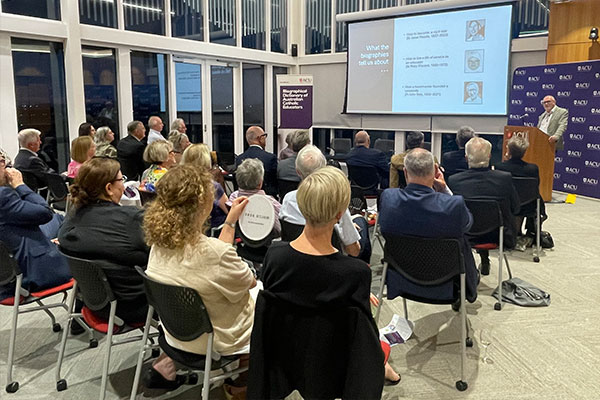
Dr Ryan’s presentation was followed by a panel discussion with former Brisbane Catholic Education director Dr Pam Betts and her successor, Peter Hill, on the need to know and share the story of Catholic education in Australia.
The BDACE is the only digital dictionary dedicated to preserving history of Catholic educators from Australian colonial settlement to today.
Hosted by ACU, the BDACE has curated nearly 100 interviews and published 130 biographies of lay, ordained, and consecrated men and women working in Catholic education since 1820.
Consultant Dr Anne Benjamin, Honorary Professor of ACU, said the BDACE was committed to preserving the memory of the faithful women and men who have served Australian children and families through education across 200 years.
“There is still so much that BDACE needs to do, and so many more Catholic educators to honour,” Dr Benjamin said.
We're available 9am–5pm AEST,
Monday to Friday
If you’ve got a question, our AskACU team has you covered. You can search FAQs, email, live chat, call – whatever works for you.

 Facebook
 Twitter
 LinkedIn
 Copy Link