
Show Me
New national data tracking Australia’s school leaders over 15 years reveals a dramatic decline in principal health and wellbeing with exposure to violence, stress and workload worse than when the landmark study began in 2011.
The latest Australian Principal Occupational Health, Safety and Wellbeing Survey of 2000 school leaders, compiled by ACU’s Institute for Positive Psychology and Education (IPPE), shows stress, burnout and workload pressures are reaching critical levels.
Marking 15 years of longitudinal tracking across government, independent and Catholic schools, the groundbreaking research provides a unique insight into the escalating pressures facing Australia’s principals.
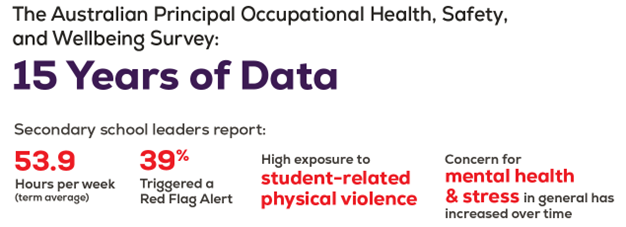
Nearly half of principals reported experiencing physical violence and more than half faced threats of violence in 2025. Anxiety and depression rates among school leaders are high with 10.3 per cent of principals recording severe anxiety scores, and levels trending upward since 2023. On average, they’re working almost 54 hours a week.
Lead investigator and school wellbeing expert Professor Theresa Dicke warns that without urgent reform to address workload, safety and mental health support, the sustainability of school leadership in Australia is at serious risk.
“Fifteen years of data tell a clear story, the evidence is unequivocal, Australia cannot strengthen its schools without first strengthening the health, safety and wellbeing of those who lead them,” Professor Dicke said.
“If nearly half of principals are experiencing physical violence and more than half are facing threats, we must ask ourselves in what other profession would this be tolerated as business as usual?”
Professor Dicke said principals now deal with complex mental health issues, workforce shortages, compliance demands and community tensions.
“Exposure to aggression has become disturbingly normalised.” she said. “Administrative and regulatory requirements have multiplied, and community expectations have intensified and yet, despite everything, principals remain deeply committed to their school communities.
“They report strong purpose and connection to their work. That commitment is extraordinary, but it is also masking risk. Commitment alone cannot offset structural overload, rising violence and chronic stress.”
Key findings:
|
State or Territory |
Threats of Violence |
Physical Violence |
||
|
2011 |
2025 |
2011 |
2025 |
|
|
ACT |
34.1% |
70.7% |
29.3% |
73.2% |
|
NSW |
28.9% |
45.0% |
21.9% |
37.8% |
|
NT |
48.8% |
72.7% |
41.9% |
75.8% |
|
QLD |
37.4% |
61.5% |
27.9% |
52.3% |
|
SA |
46.3% |
54.2% |
32.7% |
55.1% |
|
TAS |
31.1% |
60.0% |
26.7% |
60.0% |
|
VIC |
37.6% |
46.2% |
25.0% |
40.0% |
|
WA |
41.4% |
57.9% |
32.1% |
54.8% |
Emeritus Professor Philip Riley, who started the Australian Principal Occupational Health, Safety and Wellbeing Survey, said the important research has put these concerning issues firmly on the national and global agenda.
Since the survey started, Victoria, Queensland and New South Wales have each committed over $100 million to address the most pressing issues and the other states and territories are also looking at positive change.
“This project started because having been a school principal myself, I had witnessed first-hand the difficulties faced by people taking up the role,” Professor Riley, said. “The principal is the canary in the coal mine: their health and wellbeing are a good proxy for the health of the school.”
World-leading educational psychologist and co-chief investigator Professor Herb Marsh said Australia must now move from crisis management to sustainable reform.
“The power of a 15-year longitudinal study is that we can see real trends, not isolated headlines,” Professor Marsh said. “That gives policymakers something valuable, evidence about where pressure is building and where reform can make a difference.
“Violence is deeply concerning, but it does not define school leadership. What defines principals is their commitment to students, staff, and community; our responsibility now is to ensure the system supports that commitment.
“For fifteen years our data show the same thing: principals remain deeply committed to their schools. That resilience is a national asset, and it is worth protecting.”
The 2025 report calls for coordinated action to reduce workload, improve mental health support, strengthen workplace safety, support career sustainability and restore professional autonomy to ensure school leaders can thrive in their roles.
Professor Theresa Dicke and Associate Professor Paul Kidson are based in Sydney and are available for interview. Read the report here.
Media Contact: Elisabeth Tarica, Australian Catholic University on 0418 756 941 or [email protected]
We're available 9am–5pm AEST,
Monday to Friday
If you’ve got a question, our AskACU team has you covered. You can search FAQs, email, live chat, call – whatever works for you.

 Facebook
 Bluesky
 LinkedIn
 Copy Link